

Leicester were battling relegation but hadn’t succumbed yet. Their hosts were mid-table rather than sixth. Most pressingly of all, Forest had an FA Cup final on the horizon.
Leicester also went into the game in surprisingly good form, having followed six consecutive defeats including a 6-0 reverse at White Hart Lane with an unbeaten five-game run that featured a 2-1 win at Villa Park. The Leicester Mercury’s Friday preview was bullish. “Leicester must feel extremely confident about tomorrow’s match. Apart from having a good record at the City Ground, they will be meeting a Forest side that has given some poor home displays lately.”
The Leicester manager was Matt Gillies, a few months into his ten years in the Filbert Street dugout. The Nottingham Evening News praised Gillies on the morning of the game, saying he had “got together a combination that can go places.” It also stated that “Leicester’s chances of First Division survival depend to a great extent on the result of the match with Forest today.”
Gillies picked the following lineup to start in Nottingham: Maclaren, Chalmers, Baillie, Newman, Knapp, Appleton, McDonald, Keyworth, Walsh, Leek, Wills.
Forest were the better team for the first half hour and when the opening goal went in, it was against the run of play. It came for Leicester, top scorer Jimmy Walsh heading in a Johnny Newman cross. The chances kept coming for Forest, prompting the Nottingham Evening News reporter to say of visiting goalkeeper Sandy MacLaren: “The goalkeeper was playing a hero’s role in this vital stage of Leicester’s brave bid to keep First Division status.”
Seven minutes into the second half, Ken Keyworth doubled Leicester’s lead from a Gordon Wills corner and then Walsh found Tommy McDonald whose angled shot from 12 yards made it three. Roy Dwight pulled a goal back for Forest before his team-mate Bill Whare put the ball past his own keeper to give Leicester a 4-1 victory on the banks of the Trent.
Seven days later, a 2-1 win over Manchester United at Filbert Street helped seal survival for Leicester by two points – the reward for victory in those days – while Aston Villa were demoted to the second tier.
The 1958/59 season was only Forest’s fifth season in the top flight since 1911. It would see the second of their three FA Cup final appearances to date, the others bringing victory in 1898 and defeat in 1991. Leicester City, having lost to the other finalists Luton Town in the fourth round, then hosted a fifth round second replay match between Forest and Birmingham City, with Forest winning 5-0 at Filbert Street.
After defeating Bolton Wanderers and Aston Villa, thoughts among the Forest faithful turned to Wembley glory.
The Nottingham Evening News “Verdict on Forest” was damning of their efforts against Leicester and what it said about their prospects for the big game ahead:
“This sort of football is not going to bring the Cup to Nottingham. Forest seemed prepared to push the ball any way but forward, and although the Reds often looked the better side [in] midfield, Leicester’s relegation-conscious defence stood no nonsense inside their own 18-yard line.
Forest seemed quite unable to make or exploit any gaps. Leicester undoubtedly appreciated this “friend and neighbour” act but for Forest it simply set on the seal on their post semi-final run. The weeks of waiting for the final have often slackened the League standards, but this showing was inexcusable.”
In the same paper, writer Frank Hill bemoaned the seven-week gap between the semi-final on 14th March and the final on 2nd May.
“Anything can happen in seven weeks,” wrote Hill. “In certain cases players refuse to take any unnecessary risks, especially when, due to cup ties, two and three postponed games have to be played in one week, and others crowded into a very short period of time.”
Two days later, Forest were back at the City Ground to beat Aston Villa and help hasten the Birmingham club’s relegation. Defeats to Leeds United and West Bromwich Albion rounded off the league season. At long last, Wembley awaited.
On 2nd May 1959, Forest supporters streamed down to London. Some steamed down on football specials.
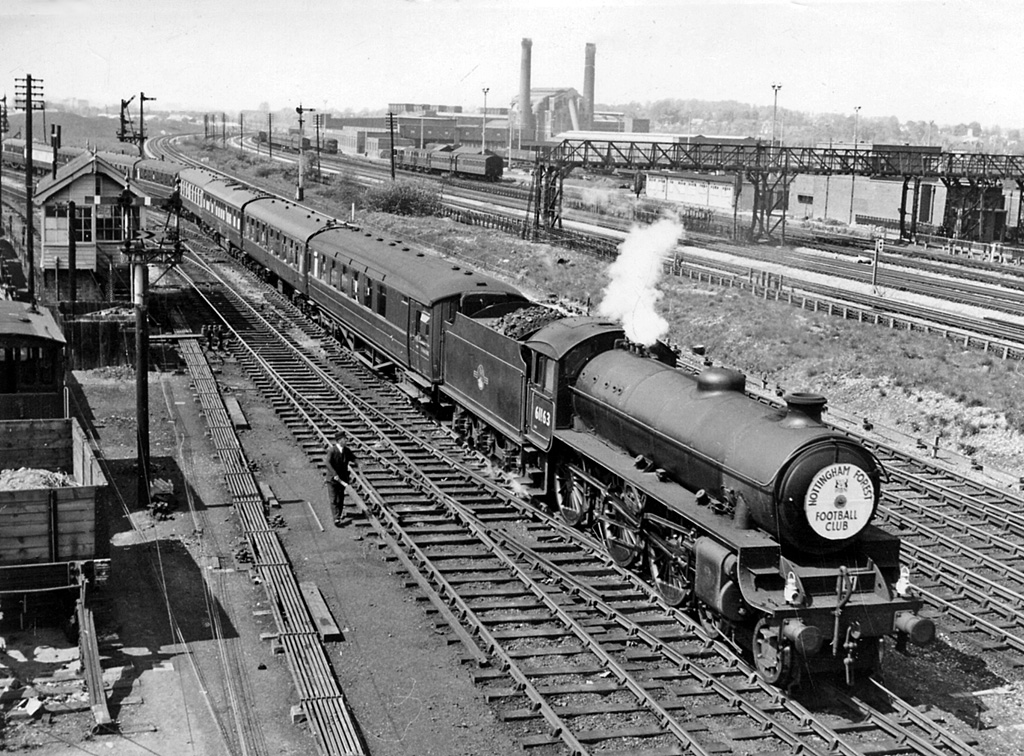
While the locomotive shown here temporarily carried the wording “Nottingham Forest FC” for the big occasion, there were already others named Nottingham Forest and Leicester City. The latter was cut up in a scrapyard on the eastern outskirts of Derby two days before Leicester’s 1959 win at Forest having carried the name for 22 years.
One of the two iconic nameplates displayed on each side of these locomotives were offered to their respective football clubs. Some have been used well, perhaps most famously at Carrow Road where Norwich City display theirs above the players’ tunnel. In 1959, Leicester City’s board of directors turned down the offer of their club’s nameplate and it had to be tracked down nearly 40 years later.
In 2016, Leicester City’s Premier League win led to the Great Central Railway temporarily renaming its locomotive Central Star as Leicester City.
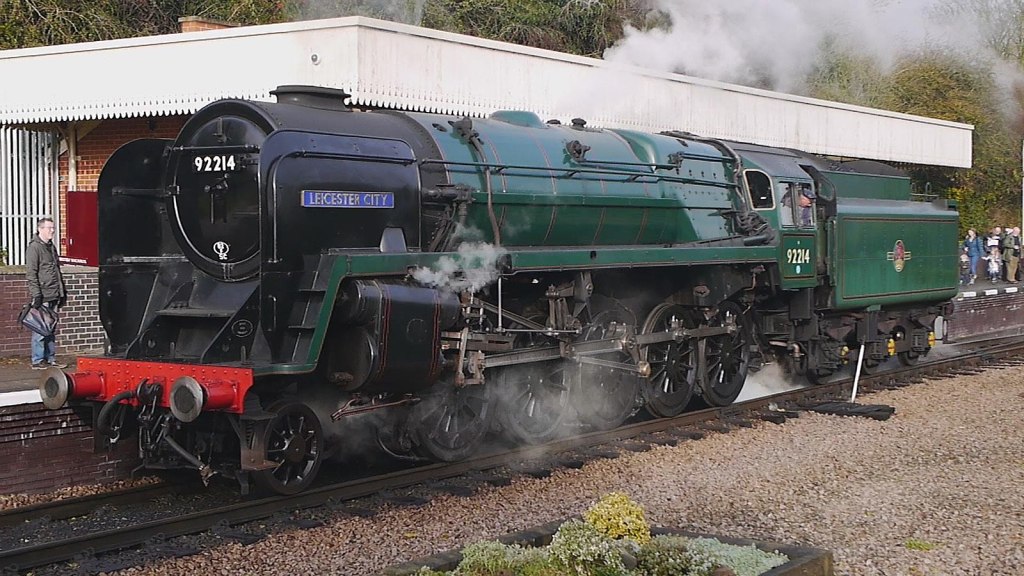
Nottingham Forest, meanwhile, took ownership of their offered nameplate in 1960 while the other of the pair was sold at auction in 2007 for £43,000.
When taking ownership, Forest were reigning FA Cup winners for the second time having beaten Luton Town 2-1 at Wembley with goals from Roy Dwight and Tommy Wilson. Leicester would have to wait a further 62 years to lift the famous trophy, before their reign was brought to an end early the following year – at the City Ground.
 The Fosse Way