

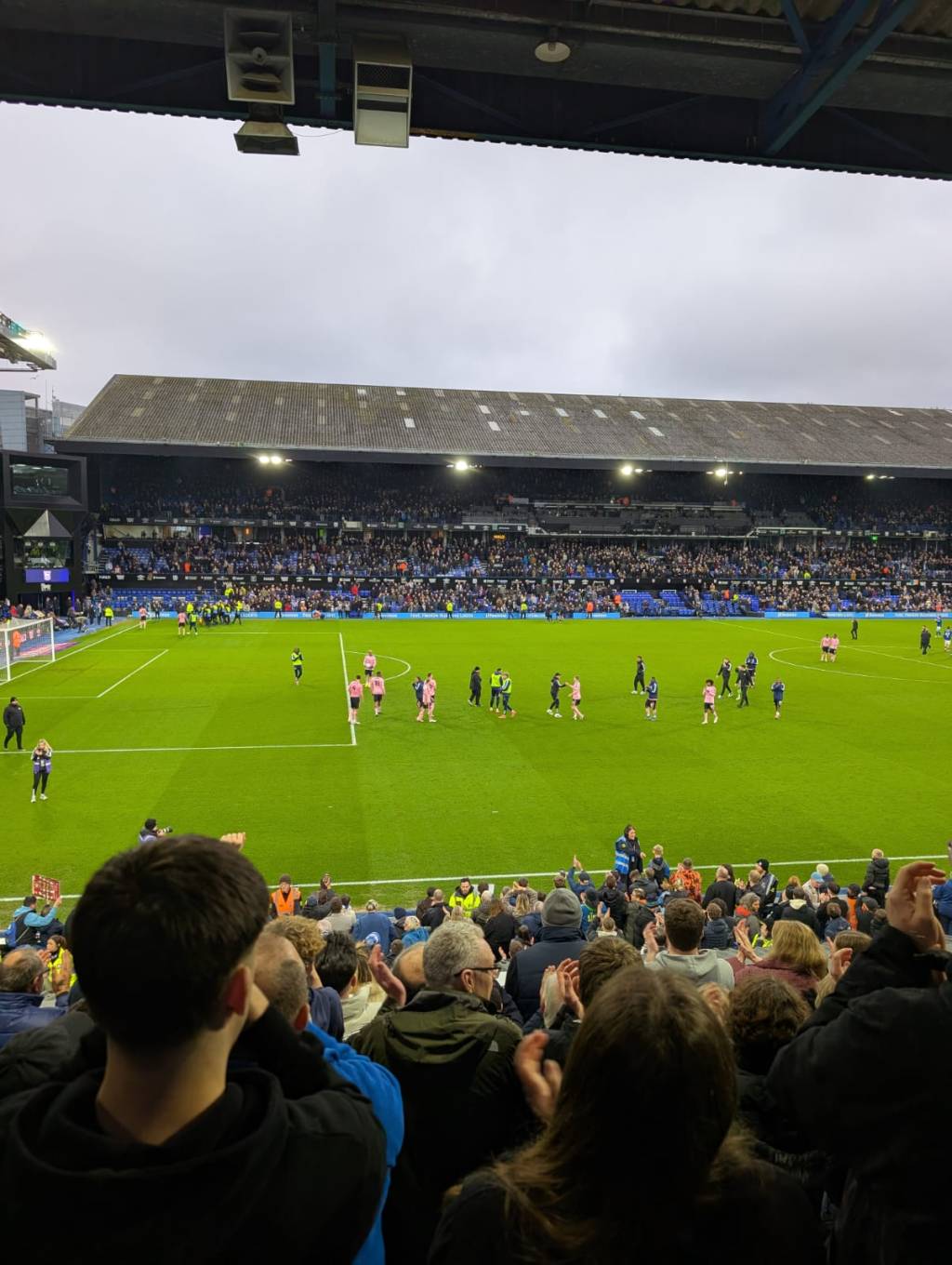
If there is one thing that Gary Rowett has done as the Leicester City manager, it has been to bring back a sense of, if not enjoyment, then at least entertainment and possibility to the games.
This campaign felt like a zombie season under Marti Cifuentes, with everyone marching mindlessly towards an inevitable end. Under Rowett, and even under Andy King before him, there’s a sense that we are at least flailing around like a dying man, rather than having already succumbed.
This game, like his two previous away trips at the helm, ended in utter chaos. A breathless second half reached its denouement as Ipswich missed two golden opportunities to steal it in stoppage time, while Jordan Ayew barraging into the box at the other end briefly brought back memories of his last gasp heroics a year ago.
Ultimately, the Foxes clung on for a valuable point. This was as much for the fact that to have conceded would have been devastating as for the actual value of the point itself. Draws aren’t going to save Leicester, but hanging on under extreme pressure could be psychologically important going into the next few games.
Rowett certainly approached this encounter with the view that those next few were more important than this one. With two home matches against mid-table teams coming up, he decided that if he was going to manage the minutes of his key players, they were going to be played on Tuesday and on Saturday rather than here. Consequently, Jordan James and Divine Mukasa, as well as Jamaal Lascelles, started the game on the bench.
Had Leicester lost comfortably, Rowett would have been heavily criticised for doing this. The sight of James trooping on at 3-0 down would not have looked particularly clever. But a manager’s job is to make difficult decisions with the whole picture in mind, and you can ultimately only judge his choice at the end of the week.
As it is, he came in with a clear plan, and for the first 15 to 20 minutes his side executed that plan superbly. They pressed well, targeting Azor Matusiwa in possession, and created a number of half-opportunities early on, the best of which saw Harry Winks drill a low shot at Christian Walton.
Leicester seem to look better in general against better teams; they have a curiously decent record against the top six. Maybe this is because there is less pressure on the Foxes to actually dictate the game. Playing a slightly more reactive style with less possession allows their counter-attacking ability to come to the fore. These teams also seem to be less physical than the morass of sides in mid-table, which suits Leicester’s rather weak and feeble team.
We saw this in glimpses throughout the first half, where Leicester were coiled like a spring to break whenever they won the ball. Although they had little of it, they were really committing men forward when they seized possession. This is a big difference to what we have seen at times this season, where a complete inability to get people forward quickly enough meant they couldn’t sustain any kind of break. In some ways that is the clearest difference between King/Rowett and what preceded them. The likes of Winks and Oliver Skipp and even Luke Thomas have been encouraged to get forward when they can.
We shouldn’t go overboard on this though because, while there were plenty of positives, you can’t really argue with the fact that Ipswich completely dominated vast stretches of the game.
In some respects, perhaps that will be a defining memory of this period in Leicester City’s history; you come out of a match nodding with satisfaction, secure in the knowledge that you played alright and deserved a point, then you try to remember a single chance of any note and draw a complete blank. Then you realise with a shudder that an opposition centre-back could have notched a double hat-trick on another day.
This version of events is borne out by the stats. Leicester managed only two shots in the entire game from inside the box. In the second half, they only managed two shots in total, and one of those was a strike from the halfway line by (answers on a postcard) Abdul Fatawu. By contrast, Ipswich had six shots from inside the six-yard box.
Partly, this is to do with the game state. The first half was relatively even, it was only after the break that an increasingly desperate home team had Leicester clinging on for dear life. Because, five minutes before the break, the postman knocked down Ipswich’s door.
The Leicester goal came from a set piece, but it was also a snapshot of what they did well in the first half. Ipswich commit a lot of players forward, and that often left them short at the back. Leicester targeted this, harrying and trying to nick the ball and have a 2v2 or 3v2 situation. On this occasion, 1v2 was all they needed: Patson Daka got ahead of his markers from one long clearance and won a free kick out on the left wing. When Luke Thomas put in a pretty ropey set piece, the suddenly prolific Daka ghosted in at the back post and volleyed it home.
From that point on, it was all Ipswich. At the break, there was a sense that Leicester needed to get through the first few minutes of the second half, as that has been the danger zone all season; often, they have conceded important goals immediately after kick off that changed the game.
They came out, and right on cue, Ipswich got the ball into the box, and Ivan Azon missed from underneath the crossbar. A few minutes later, Azon roasted Caleb Okoli on the wing, drove into the box, and flopped to the ground, which set the pattern for the entire second half. Leicester were camped back, unable to offer any kind of attacking threat, while Ipswich were swarming forward and howling for a penalty every few minutes.
In the end, it took half an hour for Ipswich to equalise. By that point, they had freshened up their forward line, the sort of depth in attacking areas that Leicester simply haven’t had for most of the season. Although they created good chances before those changes, they carried more threat afterward. The introduction of Jack Clarke, in particular, made a big difference. His direct running caused a lot of problems.
Throughout the game, Ipswich’s main outlet had been to get Leif Davis the ball in space on the left wing. While he is a good player, he is, ultimately, only a full back. Even Leicester are only humiliated by full backs a few times a season. Adding Clarke to the left side meant there was far more threat on that side as he could keep driving at the defenders. This caused a lot more problems, particularly because Fatawu put in a dreadful defensive display, regularly leaving Ricardo isolated or forcing centre backs to come out wide.
The equaliser came when Clarke cut in at the edge of the box past Fatawu far too easily and lofted a cross in to the back post. After various bits of chaos and some heroic blocks, the ball broke to Sindre Walle Egeli, who drove in under Jakub Stolarczyk.
Once Ipswich equalised, it felt like a matter of time before they won the game. This was the classic encounter where it takes the better team a long time to get level, then they go bang-bang and take the lead. They had the chances to do so, most of which came from set pieces that utterly exposed Leicester’s zonal marking strategy.
At least six times Ipswich put a deep cross in from a corner or a deep free kick and Dara O’Shea was free at the back post. Leicester’s attempt to deal with him was to use Oliver Skipp as a blocker, the effectiveness of which can be gleaned by the fact that he had three chances to win the game in stoppage time alone. Even in the first half he had hit the base of the post with an open goal, then in the dying stages he put one chance over the bar, another straight at Stolarczyk, and then headed one down for Chuba Akpom to have a shot cleared off the line.
There was still time after that for the howliest of howls for a penalty, when Hamza Choudhury blocked Cedric Kipre as a cross came in and he collapsed to the ground. Ipswich’s utter outrage at this probably reflects their frustration at having been so dominant and failed to win rather than the incident itself. See, by way of demonstration, the following momentum graphic. We’d be annoyed too.
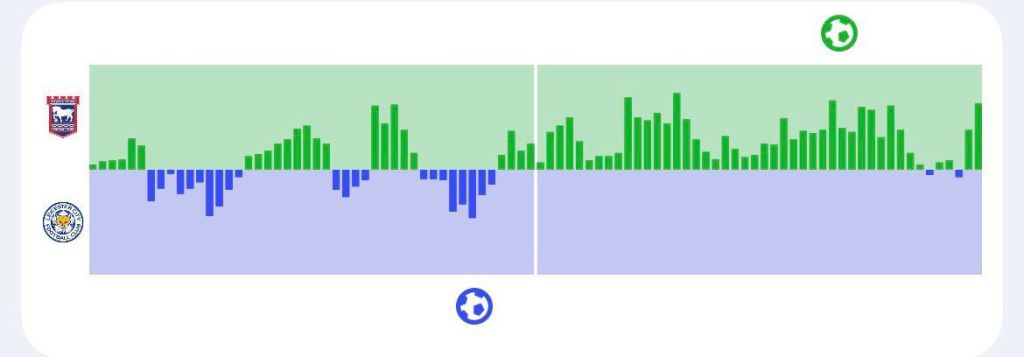
In some ways, that first half – second half split is the same pattern we’ve seen all season. The difference this time is that we got away with it. Ipswich are a very good opponent. Sometimes you just need a bit of luck, and a point is a good result. The way it happened makes it feel even better because there were plenty of times this could have been lost.
The real value or otherwise of this game will only be known later. There is a huge week ahead, which will go a long way to deciding which division Leicester are in next season. We have, by hook or by crook, started it on the right foot.
 The Fosse Way