


On Tuesday evening, Joe Clarbour settled down to watch Leicester City away at Millwall – and very soon, he was having a flashback…
Many years ago I used to conduct a kids’ music group. Thirty or so juniors learning to play a variety of brass instruments, parping and screeching their way through Old McDonald. Me stood at the front of rehearsals waving my arms about and shouting instructions over the chaotic din they were making (Ed – that’s all well and good, but what’s this got to do with Leic… oh).
On a recent trip to see my parents, we found an old video cassette of a concert performance from the time. Eager to view and hear the musical gold it doubtless contained, we put it on (yes – my parents still have a wired-in VHS player).
My long-gone, near-skeletal, early twenty-something frame, coupled with the contrast in height between me and the kids, gave my on-stage conducting presence the air of an over-sized, demented stick insect. My wild gestures and prompting having no demonstrable impact on the overall quality of the sound being made. It sounded exactly as you imagine it would – like a bunch of primary school kids learning to play a variety of brass instruments.
After that concert I recall talking with a friend, an experienced musician and musical director, about how I was getting on in my first conducting role. He said something I’ve always remembered: “Joe – no matter how much you wave your arms about, you can’t play it for them.”
Crossing the white line
Over the years I’ve periodically thought about this sage advice when watching football. The psychology of performance has always interested me – whether amateur or professional, sporting or musical, work presentation, school exam or pretty much any other example you can think of. It strikes me that many of the processes involved are fundamentally the same or at least similar enough to bear comparison across very different fields of activity.
Admittedly, very few of us will ever perform in front of a live audience of tens of thousands. We cannot know the pressure that brings to bear. Nor will most of us know the level of professionalism and dedication required to succeed at the very highest levels or fully appreciate the ultra-fine margins between success and failure in top level professional sport.
But we can and do know and appreciate something fundamental in all of this: namely that when we cross that white line, walk onto that stage, fire up a work PowerPoint or enter an exam hall, the talking is over. We are responsible for our own destiny from this point. We can take on board all the advice and direction beforehand but ultimately, on the day, we have to play it as we see it. Nobody can play it for us.
This is why I found Enzo Maresca’s apparent comment to Mads Hermansen at half time of the Birmingham match following his error for their equalising goal (that if he didn’t stick to the play out from the back gameplan he would be substituted for Jakub Stolarczyk) a little jarring.
In fairness, if such a comment was made in the dressing room, I’m sure Maresca meant it only as a means of underpinning and shoring up our young goalkeeper’s confidence going into the second half. But there is surely a real risk of over management here – even if unintentional.
Might it be that precisely this kind of messaging leads to muddled thinking that, at key moments in matches, compromises our players’ ability to apply basic common sense? Were Hermansen and Faes so constrained by the Enzoball mantra that between them they could not take the obviously sensible decision to launch a first half injury time goal kick as far up field as they physically could in order to get to the break 1-0 up?
If Hermansen’s error had occurred in the meat of the match rather than the natural margin approaching half time it would have felt different – very much like Winks’s error for Watford’s goal at Vicarage Road.
Okay, we’re trying to play a certain way, there is a risk / reward balance here and regular routine mistakes (and occasional catastrophic ones) are both to be expected and immediately forgiven and forgotten. After all, a textbook example of the benefits of Maresca’s approach was provided in the very same match in the shape of Ricardo’s one end to the other, scythe through the heart of the entire opposition, winning goal. I get it and I think the vast majority of City fans get it.
Overdoing it at The Den
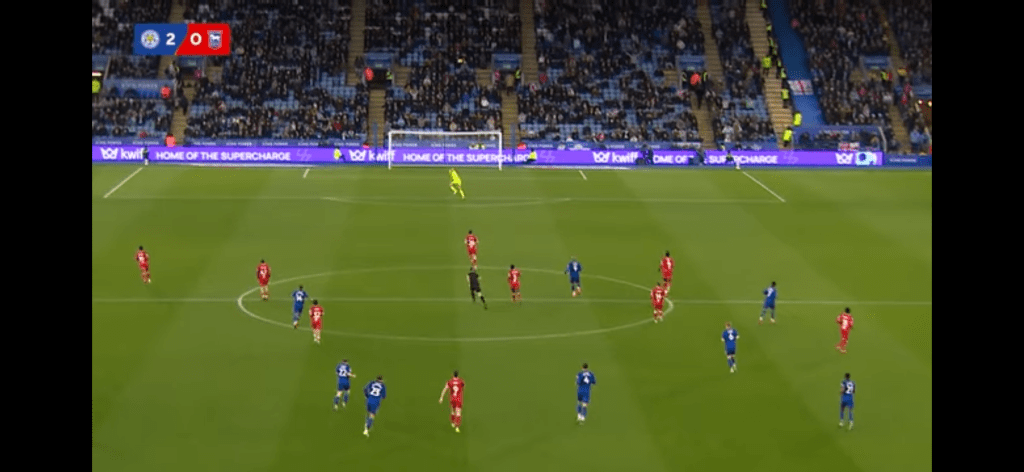
But there are always limitations to good ideas. Watching Tuesday night’s match against Millwall, our players seem so wedded to the principles of Enzoball that rather than using it as a means of achieving an end, they are adopting it as an end in itself. Whilst Millwall set up very well against us and performed admirably, being both dogged and committed in defence and having sufficient quality in attack to cause us problems throughout, there were several occasions (notably in the first half) where their aggressive pressing of our back line played right into our hands.
One or two deft touches and triangle passes later (Enzoball at its best) and we’d sprung their trap, leaving the four or five strong Millwall vanguard trailing in our wake – only for our midfield to grind to a halt and slip back into playing keep ball on the halfway line.
Why the overcomplication? What would it really have mattered had we lost possession trying to press further forwards and take full advantage of their disjointed defensive set up at that moment? Given our own defensive line was intact, what exactly did we have to fear from trying it? And why has the idea that occasionally playing the ball into space behind the opposition’s defensive line at such moments become such an apparent heresy?
Perhaps against better opposition such caution when breaking forward might be necessary but it doesn’t feel like it should be against lower-end Championship teams where it’s actually all just starting to feel a bit self-indulgent. Our team seemingly cannot be satisfied scoring anything other than the immaculate goal utilising an overload we’ve earned through the purity of our own play rather than simply having been gifted through the opposition’s naivety or mistakes.
This failure to exploit space when handed to us on a plate eventually came at a price. Millwall showed us the way to do it – gleefully pouncing on the slight (but somewhat predictable) over commitment forwards of the entire right side of our defence in search of that overload again, allowing Ryan Longman to rampage through our overstretched lines at top speed and smash an unstoppable shot into the top corner for their deserved winner.
Don’t get me wrong – I love the principles of Enzoball. It’s smart, it largely overcomes the opposition “park the bus” problem we were inevitably going to have this season and even on a bad day, provides a sufficient number of half decent chances to have won most of the matches we have lost and drawn over the past few months.
I just wish we wouldn’t keep looking gift horses in the mouth, because in doing so we’re making this promotion lark far harder than it needs to be. Empower the players to play it as they see it Enzo, give them the five or ten percent freedom of thought to not think but just act.
You can’t play it for them.

document.getElementById(‘newsnowlogo’).onclick=function(){ window.open(‘https://www.newsnow.co.uk/h/Sport/Football/Premier+League/Leicester+City’,’newsnow’); }; document.getElementById(‘newsnowlogo’).style.cursor=’pointer’; document.getElementById(‘newsnowlogo_a’).style.textDecoration=’none’; document.getElementById(‘newsnowlogo_a’).style.borderBottom=’0 none’;


 The Fosse Way
Leave a reply to Penfold Cancel reply