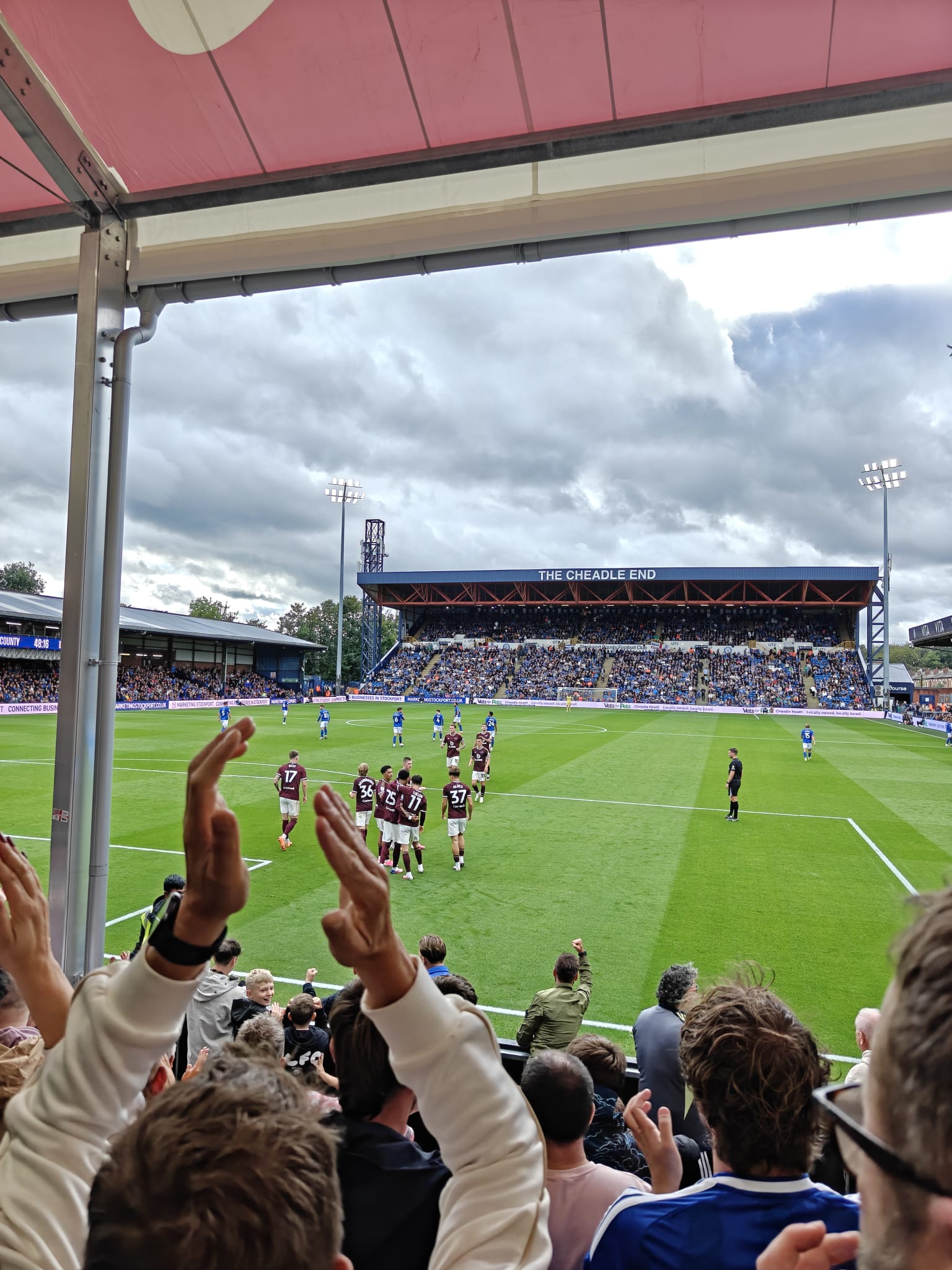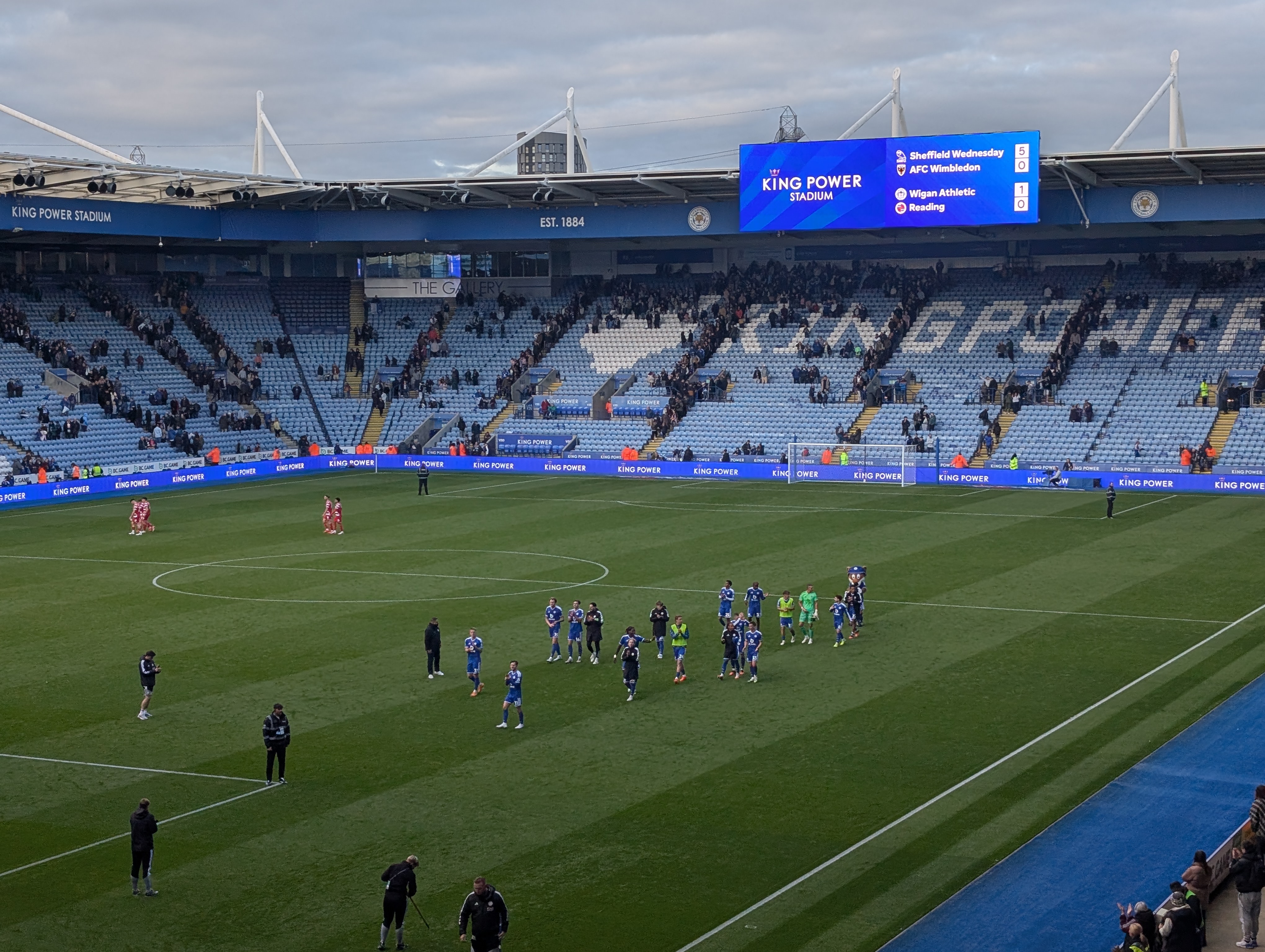
December 2025. Marti Cifuentes Leicester had just beaten Ipswich, Karen Carney was about to win Strictly Come Dancing and diesel was cheaper than liquid gold…it was also the last time Leicester had won at home on a Saturday in a league game, until the weekend’s win against Doncaster.
In between those games, the Foxes have of course been relegated to the third tier. In 2026 we have witnessed just 2 Championship wins at home, defeating West Brom (Monday night) and Bristol City (Tuesday night) alongside the solitary League One win versus Plymouth (also a Tuesday night).
My son was a player escort for the freezing cold West Brom game back in January, but as with many junior Foxes supporters, doesn’t normally go to evening games. Therefore, it’d been a long while since many fans had seen us win at home at all. Just five home wins in 2026 is the defining statistic of why we are where we are.
So, how did the win against Donny come about? Russell Martin is as famous for his arrogant stubbornness as he is for his possession football, but was Saturday the very first time he’d applied a few lessons learned and, brace yourselves, altered his style of play?
The first point to make here is an important one. There’s always a range of opinions across the fan base, but those out there calling for a return to ‘fast counter-attacking football’ are simply not going to get that from a Leicester team in League One. King Claudio himself could return to the dug-out and we’d still dominate possession in this league, especially at home.
The way teams set up (deep to mid block, don’t chase the ball, wait for the mistake) won’t change because that’s the tried and tested formula to defeat Russell Martin teams. Just as Burton, Oxford and Peterborough did. With somewhat ease.
We are going to dominate possession whether we like it or not, so the question is, how do we make best use of it?
The first major change on Saturday was the Goalkeepers role. It’s bewildering that Russell Martin prioritised signing his former Southampton custodian when Alex McCarthy is deeply uncomfortable with the round thing at his feet.
In a podcast last week McCarthy revealed that Southampton had recommended he retire due to a heart condition. He’s caused more than a few pulses to rise across his appearances this season for sure.
However, Saturday saw a change to the way the ‘keeper operated. Firstly, there were not any passes played by him across his six yard box to unsuspecting teammates who had opposition strikers breathing down their necks.
It was in fact a pretty uneventful game for the keeper. He passed out from the back with simple passes to unmarked team mates and hit a few long too. There was nothing scientific or revolutionary about this change, it was well, just normal basic behaviour. It also felt like the defenders passed to him on fewer occasions, even if that meant a longer pass forward when necessary.
Ultimately, it doesn’t matter if you’re Donnarumma at Man City, or ‘Big Bob’ in goal for the Dog and Duck, not gifting the opposition clear cut chances with bonkers passes is just basics.
Therefore, it was a welcome change and certainly made for fewer hearts racing for players and fans alike.
The next change was a little further forward. We changed to three Centre backs. A back three has been in and out of fashion over the past 30 years or so. Most teams in England and indeed across the continent go with a 2 these days, but for a Leicester team that was haemorrhaging goals, with a manager who averages more than 1.5 goals per game conceded over his career, it certainly made sense to try it.
It was very unlike Russell Martin to do something ‘different’, but credit where it’s due because it certainly was one of our better defensive displays in 2026 (yes, it’s a very very low bar).
Harry Souttar returned after being inexplicably benched in-favour of Faes at Barnsley and Okoli last week, to lead the defence and looked very much at home with Okoli and O’hora either side of him.
This provided three immediate changes to the set up.
Firstly, with the extra centre back, the inevitable rotation of possession across the back line enabled both Okoli and O’hora to carry the ball forward. The wing backs were a little higher than full backs would have been, allowing us to move the ball through the lines, rather than sideways and backwards.
Once we’d done this, O’hora was able to move into a sort of tucked-in right back role, enabling the lively and relentless Alves, in an unfamiliar role and side of the pitch, to get forward and more importantly get back – a player with athletic ability, good engine and desire, all things we’ve sadly lacked in recent times.
This provided the second benefit, with us looking less vulnerable to a counter attack than we have done for a long while. Souttar was able to occupy the centre of the pitch, with cover either side of him at Centre Back. We also had wing backs who could run up and down to plug gaps.
Russell Martin added to this with his subs, by sending on of the few players in this squad with pace towards the end of the game to see things out. Bade Aluko cut out danger in defence and carried the ball forward thereby relieving pressure to good effect.
Finally, the other major benefit was how it helped Luke Thomas. One of the most prolific sources of goals against us in recent times is a ball played over Thomas’s shoulder. His lack of awareness and perennial poor positioning has led to many a soft goal.
However, in this set-up he was a bit wider and therefore further away from the danger area, and importantly with a Centre Back closer to him. After a ropey start, which brought one booking and could on another day have brought two, he settled down and had a pretty good game. The wing back role, with less defending and more attacking suits him. It’s not a long term solution, but a step towards the team improving.
Overall, the possession percentage was down at 54% compared to 60-70% in recent games. But, there definitely was a feeling of possession with more purpose. This was combined with a licence to either play a longer pass or clear the lines when needed. The midfield combined well and Riis looked a threat throughout. It really was a better spectacle, capped by two beautiful goals by Lundstram and Doyle.
It’s important not to lose the fact that it’s just one win. For large parts, there was very little between ourselves and a very average Doncaster team. We didn’t keep a clean sheet and there were a few anxious moments in the final minutes.
However, the fact we didn’t crumble and scraped it out to win could be vital in the short term. “Even Okoli played well” was the correct assessment of my mother-in-law. “What a win” beamed my victory starved son! For the first time in 10 months, the journey home on a Saturday night for Foxes fans was upbeat.
Were the changes born out of a genuine tactical change by the manager, or by the necessity of making defeat less likely? Probably a bit of both.
Either way, the win has kept him in a job. Another home defeat would have surely have led to yet another change of manager, so this game could turn out to be a vital one in Russell Martin’s career.
The trick now is to follow it up. We haven’t won back-to-back games in over a year. The only thing consistent has been the inevitable return to the norm in the next game after a win.
To echo Matt Piper’s thoughts on BBC Radio Leicester post-match, we’ve made a change that worked, stick with it and improve things further. Kangasniemi for OG O’Hora a tempting switch for the trip to Bromley
One win only reduces the noise around the manager slightly, but if Russell Martin can learn some lessons and be a bit more pragmatic, he’ll win a few more friends along the way. The season possibly starts now.